×
Request Free Sample ×

Kindly complete the form below to receive a free sample of this Report

* Please use a valid business email

Leading companies partner with us for data-driven Insights

clients tt-cursor
Hero Background

India Product Configurator Market

ID: MRFR/ICT/59488-HCR
200 Pages
Aarti Dhapte
February 2026

India Product Configurator Market Size, Share and Trends Analysis Report By Component (Software, Service), By Type (2D Product Configurator, 3D Product Configurator), By Product Type (Complex product configurator, Simple product configurator), By Platform (Desktop, Web-Based, Mobile), By Vertical (Industrial Machinery, Energy & Power, Automotive, Furniture & Home Goods, Fashion, Others) and By End User (Manufacturers, Distributors, E-Commerce)- Forecast to 2035

Share:
Download PDF ×

We do not share your information with anyone. However, we may send you emails based on your report interest from time to time. You may contact us at any time to opt-out.

India Product Configurator Market Infographic
Purchase Options

India Product Configurator Market Summary

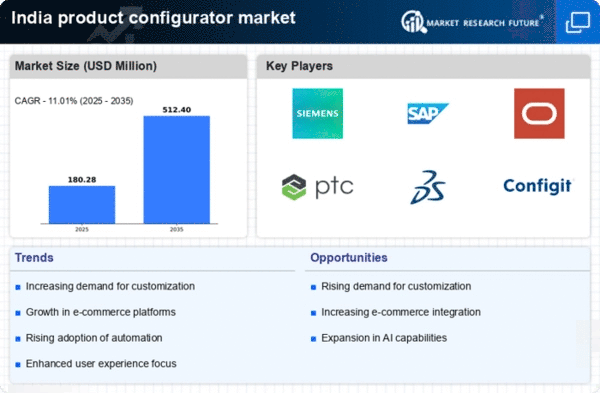
As per Market Research Future analysis, the India Product Configurator Market size was estimated at 162.4 USD Million in 2024. The Product Configurator market is projected to grow from 180.28 USD Million in 2025 to 512.4 USD Million by 2035, exhibiting a compound annual growth rate (CAGR) of 11.0% during the forecast period 2025 - 2035

Key Market Trends & Highlights

The India product configurator market is experiencing robust growth driven by technological advancements and increasing consumer demand for customization.

  • The integration of advanced technologies is reshaping the product configurator landscape, enhancing user experience and operational efficiency.
  • Customization and personalization are becoming central to consumer preferences, particularly in the automotive and furniture segments.
  • Sustainability and eco-friendly options are gaining traction, reflecting a broader societal shift towards responsible consumption.
  • Rising demand for custom solutions and technological advancements in software solutions are key drivers propelling market growth.

Market Size & Forecast

2024 Market Size 162.4 (USD Million)
2035 Market Size 512.4 (USD Million)
CAGR (2025 - 2035) 11.01%

Major Players

Siemens (DE), SAP (DE), Oracle (US), PTC (US), Dassault Systemes (FR), Configit (DK), Tacton (SE), Cimpress (US), Epicor (US)

Our Impact
Enabled $4.3B Revenue Impact for Fortune 500 and Leading Multinationals
Partnering with 2000+ Global Organizations Each Year
30K+ Citations by Top-Tier Firms in the Industry

India Product Configurator Market Trends

Notable growth in the India Product Configurator Market is driven by the increasing demand for customized products across various sectors. Businesses are recognizing the importance of offering tailored solutions to meet the unique preferences of consumers. This trend is particularly evident in industries such as automotive, furniture, and electronics, where personalization enhances customer satisfaction and loyalty. As technology advances, the integration of augmented reality and artificial intelligence into configurators is becoming more prevalent, allowing for a more immersive and interactive user experience. Furthermore, the rise of e-commerce has accelerated the adoption of online configurators, enabling consumers to visualize and modify products in real-time from the comfort of their homes. In addition, The product configurator market is likely to benefit from a growing emphasis on sustainability and eco-friendly practices. Companies are increasingly focusing on providing options that allow consumers to select environmentally friendly materials and processes. This shift not only aligns with consumer values but also helps businesses differentiate themselves in a competitive landscape. As the market evolves, it appears that the ability to offer personalized, sustainable solutions will be a key driver of success for companies operating within this space.

Integration of Advanced Technologies

The incorporation of technologies such as augmented reality (AR) and artificial intelligence (AI) is transforming the product configurator market. These innovations enhance user engagement by providing interactive and immersive experiences, allowing customers to visualize products in real-time. As these technologies become more accessible, businesses are likely to adopt them to improve customer satisfaction and streamline the design process.

Focus on Customization and Personalization

There is a growing trend towards customization and personalization in the product configurator market. Consumers increasingly seek products that reflect their individual preferences and styles. This demand encourages companies to develop configurators that offer a wide range of options, enabling users to tailor products to their specific needs, thereby enhancing the overall shopping experience.

Sustainability and Eco-Friendly Options

Sustainability is becoming a crucial consideration in the product configurator market. Companies are responding to consumer demand for eco-friendly products by integrating options that allow users to select sustainable materials and processes. This trend not only meets the expectations of environmentally conscious consumers but also positions businesses as responsible and forward-thinking in their industry.

India Product Configurator Market Drivers

Growth of E-commerce Platforms

The rapid expansion of e-commerce platforms in India is significantly influencing the product configurator market. As online shopping becomes increasingly prevalent, businesses are recognizing the necessity of offering configurators to enhance the online shopping experience. This shift is particularly relevant in sectors such as fashion and home decor, where consumers prefer to visualize and customize products before making a purchase. Data indicates that e-commerce sales in India are expected to reach $200 billion by 2026, creating a substantial opportunity for product configurators to thrive. By integrating configurators into their online platforms, companies can cater to the growing demand for personalized shopping experiences, thereby driving growth in the product configurator market.

Rising Demand for Custom Solutions

The product configurator market in India is seeing a notable surge in demand for customized solutions across various sectors. As consumers increasingly seek personalized products, businesses are compelled to adopt configurators that allow for tailored offerings. This trend is particularly evident in industries such as automotive and consumer electronics, where customization enhances customer satisfaction and loyalty. According to recent data, the market for customized products in India is projected to grow at a CAGR of 15% over the next five years. This growth is likely to drive investments in product configurator technologies, enabling companies to meet the evolving preferences of their clientele. Consequently, the product configurator market is positioned to expand significantly as businesses strive to provide unique and individualized experiences.

Increased Focus on Customer Engagement

In the competitive landscape of the product configurator market, companies are increasingly prioritizing customer engagement strategies. Engaging customers through interactive configurators not only enhances the purchasing experience but also fosters brand loyalty. Businesses are leveraging configurators to create immersive experiences that allow customers to visualize their choices in real-time. This approach is particularly effective in industries such as furniture and automotive, where customers benefit from seeing their customizations before finalizing a purchase. As customer engagement becomes a key differentiator, the product configurator market is likely to see a rise in adoption rates, with companies investing in advanced configurator solutions to enhance interaction and satisfaction.

Regulatory Support for Digital Transformation

The Indian government is actively promoting digital transformation across various sectors, which is positively impacting the product configurator market. Initiatives aimed at enhancing digital infrastructure and encouraging technology adoption are creating a conducive environment for businesses to implement configurator solutions. Regulatory support, such as tax incentives for technology investments, is further motivating companies to explore innovative configurator options. This supportive framework is expected to accelerate the growth of the product configurator market, as businesses seek to align with national digital goals. As a result, the market may experience a significant uptick in adoption rates, driven by favorable policies and a push towards modernization.

Technological Advancements in Software Solutions

Technological advancements are playing a pivotal role in shaping the product configurator market in India. The integration of artificial intelligence (AI) and machine learning (ML) into configurator software is enhancing the user experience by providing intelligent recommendations and real-time adjustments. These innovations allow businesses to streamline their operations and improve efficiency, ultimately leading to cost savings. Furthermore, the increasing adoption of cloud-based solutions is facilitating easier access to configurator tools, enabling companies of all sizes to leverage these technologies. As a result, the product configurator market is likely to witness a robust growth trajectory, with an estimated increase in market size by 20% over the next few years, driven by these technological enhancements.


Market Segment Insights

By Component: Software (Largest) vs. Services (Fastest-Growing)

In the India product configurator market, the component segment is characterized by a significant share held by software solutions, which dominate the landscape. This segment comprises various software platforms that facilitate product customization, allowing businesses to meet consumer demands efficiently. The industry's increasing digital transformation is propelling software to the forefront, solidifying its position as the largest value within the component segment. Conversely, services, although currently smaller in market share, are emerging as the fastest-growing segment. Factors such as enhanced customer support, training, and integration services are driving growth in this area. Companies are increasingly outsourcing these services to enhance consumer experience, indicating a shift towards a service-driven strategy in the market, which may complement the existing software offerings.

Software (Dominant) vs. Services (Emerging)

The software segment stands as the dominant force within the component segment, characterized by robust offerings that enable businesses to tailor products to client specifications. These software solutions provide flexibility and efficiency, addressing diverse needs across industries. On the other hand, the services segment, while still in the growth phase, is rapidly becoming an emerging player. This segment includes consulting, maintenance, and support services that are essential for optimizing software utilization. As businesses seek to enhance operational efficiency and customer satisfaction, the demand for services is expected to rise significantly, driving innovation and alignment with technological advancements.

By Type: 3D Product Configurator (Largest) vs. 2D Product Configurator (Fastest-Growing)

The market share distribution in the India product configurator market reveals a significant dominance of 3D product configurators, which are preferred for their immersive capabilities and enhanced user experience. They cater extensively to various industries such as automotive, furniture, and fashion, allowing users to visualize products in three dimensions, thus boosting customer engagement and satisfaction. In contrast, while 2D product configurators account for a smaller share, they are steadily gaining traction due to their cost-effectiveness and ease of implementation, appealing primarily to startups and small businesses. Growth trends indicate that the 2D product configurator segment is emerging as the fastest-growing due to the increasing demand for simpler and more accessible customization options. Advances in technology and the rising inclination towards online shopping are pivotal drivers for this growth. Additionally, as businesses aim to reduce operational costs while delivering personalized experiences, the adoption of 2D configurators is expected to surge. This trend is further amplified by the growing penetration of mobile and web applications, enhancing customer accessibility and interaction.

3D Product Configurator (Dominant) vs. 2D Product Configurator (Emerging)

The 3D product configurator segment stands out as the dominant force within the India product configurator market, uniquely positioning itself to offer a comprehensive and interactive design experience. It allows consumers to engage deeply with the product features, thus increasing purchase confidence. Notably, industries like automotive and furniture have harnessed this technology to create visually appealing representations that help customers in their decision-making process. In contrast, the 2D product configurator segment is emerging rapidly, driven by the demand for faster deployments and cost-effective solutions. While it may not deliver the same immersive experience, its simplicity and operational efficiency are appealing to many businesses. Both segments address unique customer needs, shaping the landscape of product configurators in the market.

By Product Type: Complex Product Configurator (Largest) vs. Simple Product Configurator (Fastest-Growing)

The India product configurator market has a diverse distribution of product types, with complex product configurators holding the largest market share. Their sophisticated functionalities are favored by enterprises looking for high customization in their offerings. In contrast, simple product configurators are emerging rapidly due to their user-friendly interfaces, making them attractive to small businesses and individual users. This growing preference for simplicity reflects a shift in market dynamics towards accessibility and ease of use. The growth of the product types is driven by evolving consumer preferences and technological advancements. Complex product configurators are being enhanced to include AI capabilities, improving their utility. Meanwhile, the rise of e-commerce has accelerated the demand for simple product configurators, as businesses seek to provide quick and efficient customer interactions. The blend of complexity and simplicity is shaping the future of product configurators in the market.

Complex Product Configurator (Dominant) vs. Simple Product Configurator (Emerging)

The complex product configurator stands out as the dominant solution in the India product configurator market, delivering advanced features that cater to businesses requiring detailed customization and integration. These configurators are typically used by larger enterprises that need to optimize their production processes and provide tailored products. On the other hand, the simple product configurator is an emerging solution, appealing to smaller businesses looking for straightforward implementation and quick setup. Its intuitive design enables users to easily navigate through options, thus facilitating a smoother customer experience. As small and medium enterprises (SMEs) increasingly enter the digital landscape, the demand for simple product configurators is expected to rise significantly, reshaping competitive dynamics within the market.

By Platform: Web-Based (Largest) vs. Mobile (Fastest-Growing)

In the India product configurator market, the distribution of market share among the platform segment values is notably skewed towards Web-Based solutions, which dominate due to their accessibility and user-friendly interfaces. Desktop platforms hold a stable share, appealing primarily to traditional users who prioritize functionality. Meanwhile, Mobile platforms are experiencing a significant rise, appealing to the growing number of users who prefer on-the-go solutions. The growth trends in this segment are influenced by rising internet penetration and the increasing use of mobile devices among consumers and businesses. Web-Based platforms benefit from enhanced connectivity and compatibility across devices, leading to a larger user base. In contrast, Mobile platforms are thriving, driven by demand for convenience and real-time accessibility, positioning them as the fastest-growing option in the market.

Web-Based (Dominant) vs. Mobile (Emerging)

Web-Based platforms are characterized by their extensive reach and robust functionalities, allowing users to access product configurators from any device with internet connectivity. They have established themselves as the dominant force in the market due to their versatility and widespread adoption across various industries. On the other hand, Mobile platforms represent the emerging frontier, catering specifically to users seeking instant access and mobility. Their growth is propelled by the increasing reliance on smartphones and tablets, making them a vital segment that is rapidly closing the gap with traditional platforms. The distinguishing factor lies in Web-Based solutions' comprehensive capabilities versus Mobile platforms' convenience and quick access.

By Vertical: Industrial Machinery (Largest) vs. Automotive (Fastest-Growing)

The India product configurator market shows a diverse distribution of market share across various verticals. Among these, Industrial Machinery holds the largest share due to the increasing demand for customized solutions in manufacturing. Automotive follows closely, leveraging technological advancements to enhance product offerings and streamline production processes, effectively gaining traction in the market. Growth trends reveal a significant shift towards automation and digitization, particularly in sectors such as Automotive and Energy & Power. The push for efficiency and cost-effectiveness drives the adoption of product configurators. Additionally, the rise in online retail and a focus on customer experience are key factors influencing growth, as businesses seek to provide tailored solutions that meet consumer needs.

Industrial Machinery: Dominant vs. Automotive: Emerging

Industrial Machinery is a dominant segment in the India product configurator market, characterized by its emphasis on precision and customization to enhance operational efficiency. This sector benefits from advances in technology, allowing manufacturers to create tailored products that meet specific requirements. On the other hand, Automotive is emerging rapidly, driven by innovative design processes and a shift towards electric vehicles. This segment focuses on enhancing customer engagement through interactive and customizable options, appealing to a tech-savvy consumer base. Together, these segments underline the importance of adaptability and responsiveness in the ever-evolving market landscape.

By End User: Manufacturers (Largest) vs. E-Commerce (Fastest-Growing)

In the India product configurator market, the distribution among end users shows that manufacturers hold the largest share, capitalizing on the need for tailored solutions that enhance production efficiency. Distributors are also significant players, facilitating the connection between manufacturers and retailers. E-commerce, however, is witnessing rapid growth as online shopping continues to expand, offering customized products that cater to consumer preferences. Growth trends indicate that the manufacturer segment is primarily driven by advancements in technology and increasing demand for customized solutions across various industries. On the other hand, the e-commerce segment’s growth is propelled by changing consumer behavior and the rise of digital platforms, allowing for a wide reach and the ability to provide personalized offerings, thus fueling its status as the fastest-growing segment.

Manufacturers (Dominant) vs. E-Commerce (Emerging)

Manufacturers play a dominant role in the India product configurator market, focusing on providing customized solutions that meet specific operational needs. Their emphasis on innovation and product adaptability helps them maintain a strong foothold. Conversely, e-commerce is emerging as a vital segment in this market, leveraging online platforms to cater to a tech-savvy consumer base. The agility and convenience of e-commerce allow for quick adjustments to consumer demands, making it a promising avenue for market growth. Both segments exemplify the dynamic nature of the industry, with manufacturers focusing on stability and e-commerce prioritizing adaptability to capture market opportunities.

Get more detailed insights about India Product Configurator Market

Key Players and Competitive Insights

The product configurator market is currently characterized by a dynamic competitive landscape, driven by technological advancements and increasing demand for customized solutions across various industries. Key players such as Siemens (DE), SAP (DE), and Oracle (US) are strategically positioned to leverage their extensive portfolios and technological expertise. Siemens (DE) focuses on integrating IoT capabilities into its configurator solutions, enhancing real-time data utilization for better customer experiences. Meanwhile, SAP (DE) emphasizes cloud-based solutions, aiming to streamline operations and improve scalability for businesses. Oracle (US) is investing heavily in AI-driven configurators, which are expected to enhance decision-making processes and operational efficiency. Collectively, these strategies indicate a shift towards more integrated and intelligent configurator solutions, shaping a competitive environment that prioritizes innovation and customer-centricity.In terms of business tactics, companies are increasingly localizing manufacturing and optimizing supply chains to respond swiftly to market demands. The competitive structure of the market appears moderately fragmented, with several players vying for market share. However, the influence of major companies is substantial, as they set benchmarks for technological advancements and customer service standards. This competitive interplay fosters an environment where smaller firms may struggle to keep pace, yet also encourages innovation as they seek to differentiate themselves.

In October Siemens (DE) announced a partnership with a leading automotive manufacturer to develop a bespoke product configurator tailored for electric vehicles. This collaboration is significant as it not only showcases Siemens' commitment to sustainability but also positions it at the forefront of the burgeoning electric vehicle market. By integrating advanced configurator capabilities, Siemens aims to enhance the customization options available to consumers, thereby driving sales and customer satisfaction.

In September SAP (DE) launched a new version of its product configurator that incorporates machine learning algorithms to predict customer preferences more accurately. This strategic move is crucial as it allows businesses to offer personalized solutions, thereby increasing conversion rates. The integration of AI into the configurator enhances user experience and positions SAP as a leader in the digital transformation of product customization.

In August Oracle (US) expanded its configurator offerings by acquiring a startup specializing in augmented reality (AR) technologies. This acquisition is pivotal as it enables Oracle to provide immersive configurator experiences, allowing customers to visualize products in real-time. The incorporation of AR is likely to redefine customer engagement strategies, making the purchasing process more interactive and appealing.

As of November the competitive trends in the product configurator market are increasingly defined by digitalization, sustainability, and AI integration. Strategic alliances among key players are shaping the landscape, fostering innovation and enhancing product offerings. The shift from price-based competition to a focus on technological advancement and supply chain reliability is evident. Companies are likely to differentiate themselves through innovative solutions that not only meet customer needs but also align with broader sustainability goals.

Key Companies in the India Product Configurator Market include

Industry Developments

SAP India demonstrated in April 2025 how AI, with its Joule copilot embedded in SAP Business Cloud and the Business Technology Platform, is revolutionizing business operations in the manufacturing and associated sectors. Indian enterprises are currently able to capitalize on AI-driven task automation, predictive forecasting, intelligent product recommendations, and the generation of sales orders from unstructured data. These capabilities have the potential to improve configurator-based sales and customization workflows.SAP PLM Variant Configuration within S/4HANA will incorporate business-driven and engineering-driven rules across CTO/MTP use cases by leveraging AI/ML starting in March 2023. 

This will enhance the accuracy and speed of configurable product selection during sales processes. SAP Commerce Cloud and variant configuration modules are being employed by Indian manufacturers to actively deploy these capabilities.Siemens expanded its digitalization portfolio in India in January 2023, with a focus on the digitization of machine tools and additive manufacturing. Although this initiative does not explicitly refer to product configurators, it encompasses Siemens' Xcelerator platform, which is currently accessible in India and includes tools such as the 3D Product Configurator. Digital twin, IoT, and configurator-like solutions are supported by these offerings for Indian industrial consumers.

Future Outlook

India Product Configurator Market Future Outlook

The Product Configurator Market in India is projected to grow at 11.01% CAGR from 2025 to 2035, driven by technological advancements and increasing customization demands.

New opportunities lie in:

  • Integration of AI-driven design tools for enhanced user experience.
  • Expansion into e-commerce platforms for direct consumer engagement.
  • Development of mobile applications for on-the-go product configuration.

By 2035, the market is expected to achieve substantial growth, driven by innovation and consumer preferences.

Market Segmentation

India Product Configurator Market Type Outlook

  • 2D Product Configurator
  • 3D Product Configurator

India Product Configurator Market End User Outlook

  • Manufacturers
  • Distributors
  • E-Commerce

India Product Configurator Market Platform Outlook

  • Desktop
  • Web-Based
  • Mobile

India Product Configurator Market Vertical Outlook

  • Industrial Machinery
  • Energy & Power
  • Automotive
  • Furniture & Home Goods
  • Fashion
  • Others

India Product Configurator Market Component Outlook

  • Software
  • Services

India Product Configurator Market Product Type Outlook

  • Complex product configurator
  • Simple product configurator

Report Scope

MARKET SIZE 2024 162.4(USD Million)
MARKET SIZE 2025 180.28(USD Million)
MARKET SIZE 2035 512.4(USD Million)
COMPOUND ANNUAL GROWTH RATE (CAGR) 11.01% (2025 - 2035)
REPORT COVERAGE Revenue Forecast, Competitive Landscape, Growth Factors, and Trends
BASE YEAR 2024
Market Forecast Period 2025 - 2035
Historical Data 2019 - 2024
Market Forecast Units USD Million
Key Companies Profiled Siemens (DE), SAP (DE), Oracle (US), PTC (US), Dassault Systemes (FR), Configit (DK), Tacton (SE), Cimpress (US), Epicor (US)
Segments Covered Component, Type, Product Type, Platform, Vertical, End User
Key Market Opportunities Integration of artificial intelligence enhances customization capabilities in the product configurator market.
Key Market Dynamics Rising demand for personalized products drives innovation in the product configurator market, enhancing customer engagement.
Countries Covered India
Leave a Comment

FAQs

What is the expected market size of the India Product Configurator Market in 2024?

The India Product Configurator Market is expected to be valued at 162.4 million USD in 2024.

What is the projected market size for the India Product Configurator Market by 2035?

By 2035, the India Product Configurator Market is anticipated to be valued at 663.7 million USD.

What is the expected CAGR for the India Product Configurator Market from 2025 to 2035?

The market is expected to grow at a CAGR of 13.653 percent from 2025 to 2035.

What are the main components driving the India Product Configurator Market?

The market is divided into software and service components, with software having a value of 97.1 million USD in 2024.

What is the expected valuation of the service component in the India Product Configurator Market by 2035?

The service component is expected to reach a value of 259.6 million USD by 2035.

Who are the key players in the India Product Configurator Market?

Major players include Katana, SAP, Model N, Tacton, ProShop, Siemens, and Oracle among others.

What are the expected growth trends in the India Product Configurator Market?

The market is witnessing growth driven by advancements in technology and increased demand for customization in products.

What applications are driving the demand in the India Product Configurator Market?

The primary applications include manufacturing, automotive, and fashion sectors where customization is a key focus.

How is the competition in the India Product Configurator Market expected to evolve?

The competition is likely to grow, with emerging players entering and established companies enhancing their service offerings.

What are the challenges facing the India Product Configurator Market?

Challenges include integrating configurators with existing systems and meeting evolving customer expectations.

Download Free Sample

Kindly complete the form below to receive a free sample of this Report

Compare Licence

×
Features License Type
Single User Multiuser License Enterprise User
Price $4,950 $5,950 $7,250
Maximum User Access Limit 1 User Upto 10 Users Unrestricted Access Throughout the Organization
Free Customization
Direct Access to Analyst
Deliverable Format
Platform Access
Discount on Next Purchase 10% 15% 15%
Printable Versions